

The UK EMT midwife who found more than she expected after Hurricane Melissa.
Hurricane Melissa hit Jamaica hard, devastating many of the healthcare facilities in the west of the Island. However, ‘birth doesn’t stop during a crisis’ says Camella Main, an NHS specialist midwife from West Sussex, responded as part of the UK Emergency Medical Team (UK EMT), following the hurricane.
During her six weeks in Trelawny Parish, northwest Jamaica, Camella ran specialist midwifery clinics at UK EMT temporary health units, supporting the Jamaican Ministry of Health and Wellbeing to meet patient needs after the devastation.
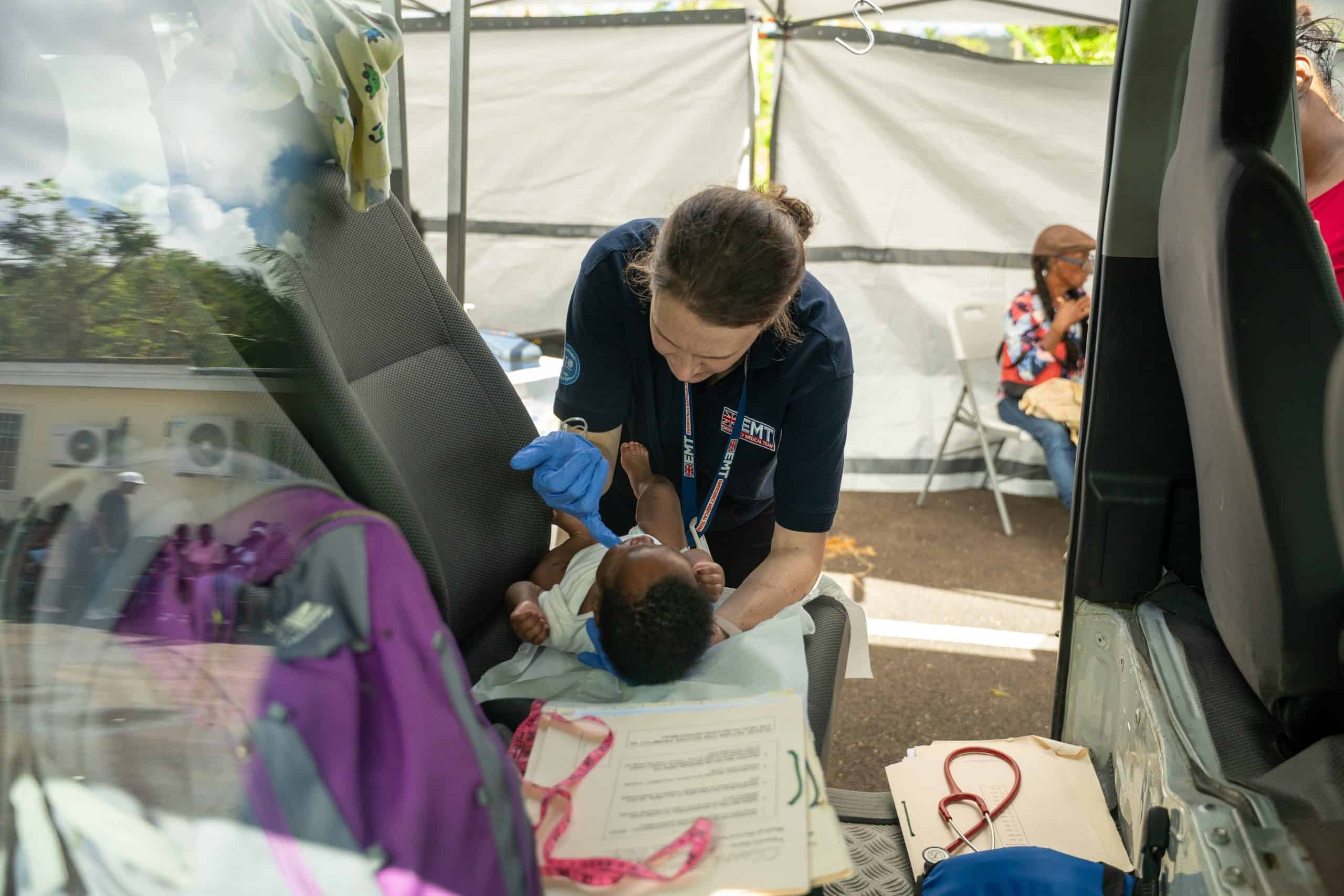
On the first day of one clinic, Camella was worried about a baby brought in by her mother, Nicketta, for a check-up. Nicketta expressed concern about her six-week-old child, born just days before the hurricane hit.
“The baby was breathing fast when at rest, and the heartbeat was much faster than expected. There was also an extra sound, what we know as a murmur.” (Camella Main)

Camella’s experience and professionalism meant she had identified a heart condition that needed further investigation. If the UK EMT not been running the clinic that day, this may not have been picked up quickly enough, and the child might have developed serious complications. With many health facilities out of action after the disaster, routine healthcare in Jamaica was massively impacted.
“The mother was worried that she had done something wrong, to give her child the problem. I reassured her that it wasn’t her fault and made sure she understood what was happening.” (Camella Main)
Working closely with the national staff, Camella referred Nicketta’s baby for further investigation at Falmouth Public General Hospital, which itself had been badly damaged in the hurricane. This started a pathway to care, meaning the baby has every chance of being healthy. Speaking after her child undergone further care, Nicketta said,
“My baby is doing better now, but if it wasn’t for you guys (UK EMT) I wouldn’t have known what was going on.”
Astonishingly, this wasn’t the only case of a heart condition in a newborn that Camella came across in Jamaica. Across the UK EMT response, she identified three very similar cases, all of whom could potentially need further care. Reflecting on her time in Jamaica, Camella is incredibly humble.
“My small part was helping this child and others get the healthcare they needed after the hurricane. It was a privilege to be a part of that”
However, each UK EMT response is far from a one-way street, with team members learning from every deployment. The skills and experience gained in the field are brought back to the UK and the NHS in many forms and Camella’s time in Jamaica was no exception:
“I learn so much from working across the world. That can be anything from small techniques, like better communication with patients from different backgrounds, to understanding system wide approaches to midwifery and improving knowledge sharing.”
UK-Med operates the UK Government’s Emergency Medical Team, funded by the Foreign Commonwealth & Development Office, responding when disaster strikes to deliver life-saving care around the world.
Read more about our work in Jamaica: 5 Questions Answered